
College Connect
Preparing your experience...
Preparing your experience...

Need help? 👋
We're here to help you
Looking for the right college, course or admission guidance? Choose an option below.
Preparing for college admission in India? Use this complete checklist to understand commonly required academic certificates, identity proof, entrance examination records, category certificates and course-specific documents before applying.
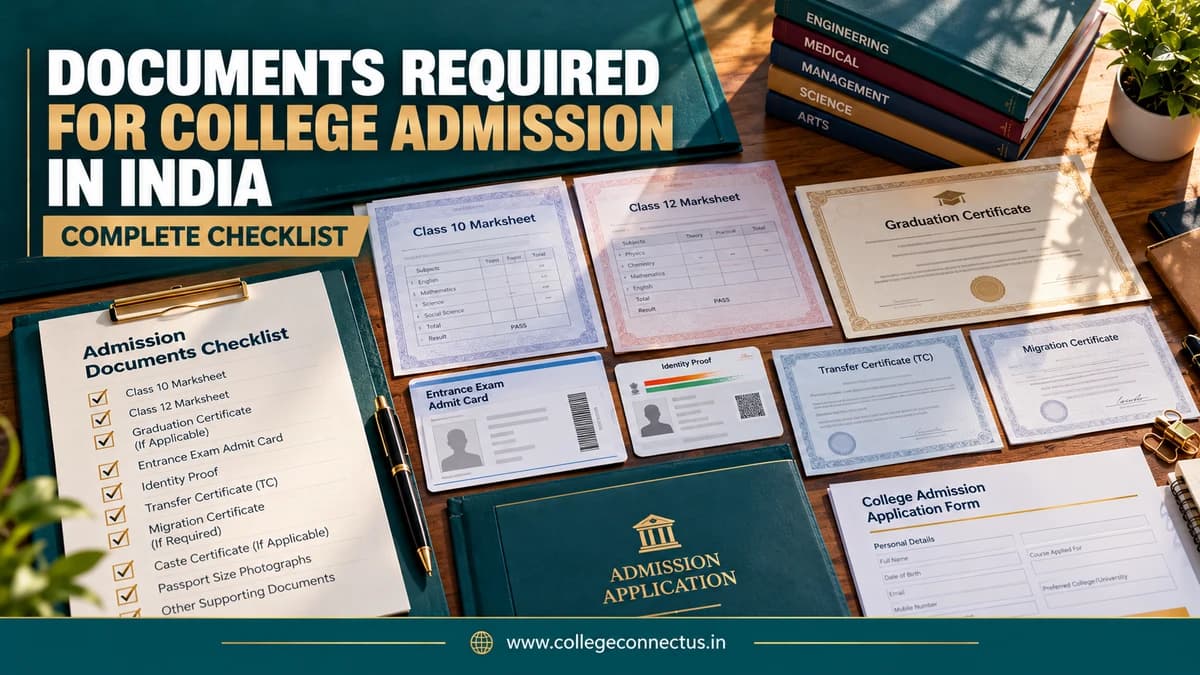
Preparing the correct documents is an important part of the college admission process in India. Whether you are applying for an undergraduate course, postgraduate program, professional degree or diploma, the college may ask you to provide academic records, identity proof, application details and other supporting certificates.
However, there is no single document list that applies to every college. Requirements vary by institution, course, admission method, counselling authority and academic year. Some documents may be required during the online application, while others may be checked during counselling, physical reporting or final enrolment.
This guide explains the commonly requested documents for college admission in India, the additional documents that may apply to specific students and how to prepare your admission file.
Colleges and admission authorities use documents to verify an applicant's identity, educational qualifications, eligibility and information submitted in the application form.
Depending on the admission process, documents may be checked to confirm:
Your date of birth and identity.
Your qualifying examination and academic results.
Your eligibility for the selected course.
Your entrance examination details, where applicable.
Your claim for reservation, domicile or other benefits, where applicable.
Your transfer from a previous school or college.
Your eligibility for a scholarship or fee concession, where applicable.
Submitting a complete and accurate application can help prevent avoidable delays. However, document submission alone does not guarantee admission; selection and enrolment depend on the applicable rules.
The following documents are commonly requested in many admission processes. This is a general preparation checklist, not a mandatory list for every institution. Before applying, compare colleges based on eligibility, course options, fees and facilities.
Class 10 marksheet or certificate.
Class 12 marksheet or qualifying examination certificate, for applicable undergraduate courses.
Graduation marksheets and degree certificate, where required for postgraduate admission.
Marksheets for previous semesters or years, where applicable.
Provisional certificate or other proof of qualification, if accepted by the institution.
An identity document accepted by the college or admission authority.
Recent passport-size photographs, if requested.
Signature image, if required by the online application.
Submitted application form or application confirmation.
Entrance examination admit card or scorecard, where applicable.
Admission offer, allotment letter or counselling confirmation, where applicable.
Important: Do not assume that every college requires every item above. Check the current official document checklist and whether original documents, photocopies, self-attested copies or digitally issued records are accepted.
Undergraduate admission requirements depend on the course and the institution's selection process.
Colleges may ask for:
Class 10 marksheet or certificate.
Class 12 marksheet or qualifying examination certificate.
Identity proof accepted by the institution.
Photographs and signature, if requested.
Application confirmation and fee receipt.
Entrance examination score or other selection records, if applicable.
Transfer or migration certificate, where required.
Some universities use qualifying examination marks, while others use entrance examinations or university-specific selection methods. Confirm the required subject combinations and eligibility conditions before applying.
Depending on the institution and admission route, applicants may need:
Class 10 certificate or marksheet.
Class 12 marksheet or qualifying examination documents.
Entrance examination scorecard, where applicable.
Counselling registration or seat-allocation documents, where applicable.
Identity proof and application confirmation.
Category, domicile or other certificates, if claiming an applicable benefit.
Additional documents specified in the institution's admission instructions.
For example, the document requirements for a participating JoSAA seat-allocation process may differ from those for a state counselling system or an institution's own admission process.
If you are planning to study engineering, explore our guide on how to choose the best engineering college in India.
Applicants should follow the applicable examination, counselling and institution-specific requirements. Depending on the program and admission route, requested documents may include:
Class 10 certificate or other accepted date-of-birth proof.
Class 12 marksheet and qualifying examination documents.
NEET-UG scorecard and related examination records, where required.
Counselling registration or allotment documents, where applicable.
Identity proof.
Category or other eligibility certificates, where relevant.
Additional forms or certificates required by the institution or counselling authority.
Medical admissions have specific eligibility, examination and counselling rules. Follow the current official instructions for the exact course and seat category.
The college may request:
Class 10 and Class 12 academic records.
Identity proof.
Application confirmation and payment receipt.
Entrance examination results, if required.
Interview, aptitude test or other selection documents, where applicable.
Additional documents listed in the institution's admission brochure.
Requirements vary by institution and course. Applicants may need qualifying examination records, entrance examination details, identity proof, application confirmation and other documents specified in the current admission instructions.
Students applying for postgraduate courses may need additional academic records from their previous degree.
Commonly requested documents may include:
Graduation marksheets for all required semesters or years.
Degree certificate or accepted provisional certificate.
Class 10 and Class 12 records, if requested.
Entrance examination scorecard, where applicable.
Identity proof and photographs, if required.
Application confirmation and fee receipt.
Transfer or migration certificate, where applicable.
Work-experience documents, if required for the selected program.
Category or other eligibility certificates, where relevant.
For programs such as an MBA, MCA, M.Sc, MA, M.Com or postgraduate professional degree, check the specific eligibility and selection requirements. Not every program asks for work experience, an interview or the same entrance examination.
If your final-year results are pending, verify whether provisional application or conditional admission is permitted. Do not assume that all colleges accept pending results.
If your admission process includes an entrance examination, keep the relevant records accessible.
Depending on the examination and admission route, these may include:
Entrance examination application confirmation.
Admit card.
Scorecard or result.
Rank card, where issued separately.
Counselling registration confirmation.
Seat-allocation letter or admission offer.
Fee-payment receipt or seat-acceptance confirmation, where applicable.
Some authorities verify examination details electronically, but applicants should follow the published instructions about uploading, carrying or presenting documents.
Do not rely only on screenshots of results if the authority requires an official scorecard or downloadable document.
Students claiming a reservation benefit, domicile-based eligibility or another specified concession may need supporting certificates.
Depending on the applicable admission rules, these can include:
Scheduled Caste (SC) certificate.
Scheduled Tribe (ST) certificate.
Other Backward Classes (OBC) or OBC-NCL certificate, where applicable.
Economically Weaker Sections (EWS) certificate, where applicable.
Persons with Disabilities (PwD) or disability-related certificate, where applicable.
State domicile or residence certificate, where required.
Income certificate, where required for a benefit or fee concession.
Other certificates explicitly required by the admission authority.
The format, issuing authority, validity period and eligibility conditions can differ between admission systems. For example, a certificate accepted by one authority may not satisfy another authority's requirements.
Before applying, check the current information bulletin and download the prescribed format if one is provided. Do not assume that an older certificate or a certificate issued for a different purpose will automatically be accepted.
If you are not claiming a category or benefit, you may not need the corresponding certificate.
These two documents can sound similar, but their purposes and requirements may differ.
A transfer certificate, sometimes called a school or college leaving certificate, is issued by the previous institution to document a student's departure or transfer. A receiving institution may request it during admission or enrolment.
A migration certificate may be required when a student moves between educational boards or universities, depending on the institution's rules and the student's academic history.
Not every college requires both documents, and some institutions may use alternative records or digital processes. Confirm the exact requirement with your receiving college before requesting certificates from your previous institution.
If a certificate is delayed, ask the admission office whether an alternative or provisional arrangement is permitted. Obtain the answer through an official communication channel.
If you plan to apply for a scholarship or fee concession, prepare the supporting documents specified by the relevant scheme.
Depending on eligibility and scheme rules, these may include:
Income certificate.
Category certificate, where relevant.
Domicile or residence certificate, where required.
Academic marksheets.
Bank account details or proof in the prescribed format.
Identity details required by the scheme.
Institution admission confirmation or fee receipt.
Other declarations or certificates specified by the scholarship authority.
Requirements differ across central, state and institutional schemes. Some schemes have separate application portals, deadlines and renewal conditions.
Admission to a college does not automatically mean that a scholarship has been approved. Verify eligibility and submit a separate application if required.
Before finalizing a college, learn how to compare college fees and placement packages to understand education costs and career outcomes.
If you intend to stay in a college hostel, the hostel application may have its own checklist.
Depending on the institution, you may be asked for:
College admission or enrolment confirmation.
Hostel application form.
Identity details.
Photographs, where requested.
Fee-payment receipt.
Medical or health-related forms, if required by the institution.
Parent or guardian contact details.
Undertakings or declarations specified by the hostel.
Hostel admission is often handled separately from academic admission. Confirm the hostel application process, available accommodation, fee structure and reporting requirements with the institution.
Many admission processes involve online forms and document uploads. Preparing clear, correctly formatted files can help reduce application errors.
Follow these steps:
Read the official upload instructions. Check accepted file formats, file-size limits, image dimensions and naming requirements.
Use clear, complete scans. Ensure the text, photograph, seals and relevant details are visible.
Check file orientation. Pages should be upright and readable.
Use the prescribed file type. Do not convert documents into an unsupported format.
Check personal details. Confirm that your name, date of birth and academic information match the relevant records.
Review every upload before submission. Make sure each file corresponds to the correct document field.
Save the confirmation. Keep the submitted application, receipt and acknowledgement.
Do not alter certificates, marksheets or other official records. If a correction is needed, contact the issuing authority or follow the official correction process.
DigiLocker can provide access to digital documents issued by participating institutions and authorities. Whether a particular digital document is accepted for a specific admission process depends on the applicable rules and the instructions of the receiving institution or authority.
Before relying on a digital document:
Check whether the institution accepts the relevant DigiLocker-issued record.
Follow any instructions for retrieving or sharing the document.
Ensure that the document is issued or available through the appropriate official service.
Keep any additional records required by the admission authority.
Do not assume that a scan uploaded by a user is equivalent to an issuer-issued digital document, or that every college accepts every digital record in place of an original.
Official service: https://www.digilocker.gov.in/
Some admission processes require original documents for verification, while others allow online verification, digitally issued records or specific copies. Requirements may also differ between application, counselling and final reporting.
Prepare a folder with your original records and a separate set of photocopies if requested. Keep digital copies stored securely for your own use.
Before travelling to a college or counselling center, verify:
Which originals must be presented.
Whether self-attested copies are required.
Whether originals will be returned immediately after verification.
Whether documents must be uploaded in advance.
Whether a parent or guardian must accompany you, if specified.
Whether any document must be submitted permanently or temporarily.
Do not hand over original documents without understanding the official process and obtaining an acknowledgement where applicable.
Avoid these common errors when preparing for college admission:
Uploading an incomplete or unreadable marksheet.
Entering personal details that do not match official records.
Submitting an expired or incorrectly formatted certificate.
Assuming that the same document list applies to every college.
Forgetting an entrance examination scorecard or allotment letter when required.
Confusing a transfer certificate with a migration certificate.
Missing a separate hostel or scholarship application.
Uploading a user-created scan when the authority requires an issuer-issued digital record.
Waiting until the final day to request certificates from a previous institution.
Sharing identity documents or personal information with unofficial agents or unverified websites.
When in doubt, contact the college's official admission office and keep a record of its instructions.
Use this checklist as a starting point. Tick only the documents that apply to your course and admission process.
Class 10 marksheet or certificate.
Class 12 marksheet or qualifying examination certificate.
Graduation marksheets and degree certificate, if required.
Previous semester or year marksheets, if required.
Provisional qualification certificate, if accepted.
Accepted identity document.
Photograph and signature files, if requested.
Application confirmation.
Application fee receipt.
Entrance examination admit card or scorecard, if applicable.
Merit-list result, offer letter or seat-allocation letter, if applicable.
Transfer certificate, if required.
Migration certificate, if required.
Category or reservation certificate, if applicable.
Domicile or residence certificate, if applicable.
Income certificate, if required for a relevant benefit.
Disability-related certificate, if applicable.
Scholarship documents, if applying for a scheme.
Hostel documents, if applying for accommodation.
Any additional course-specific form or certificate.
Recheck the official college document list.
Confirm which originals and copies are required.
Verify digital upload formats and file-size limits.
Save application and payment acknowledgements.
Check reporting and fee-payment instructions.
Keep a copy of the final admission confirmation.
This checklist is for preparation. The official admission notice takes precedence if it specifies different or additional requirements.
Commonly requested documents include academic marksheets, qualifying examination certificates, identity proof, application confirmation and photographs or signature files where required. Entrance examination records, transfer certificates, migration certificates and category documents may also be necessary depending on the admission process.
Some colleges require originals for verification, while others use online or digital verification procedures. Check the current instructions for your institution and admission route before travelling or submitting documents.
No. The requirement depends on the institution, university, previous educational board or university and applicable admission rules. Ask your receiving college whether you need a migration certificate or an alternative document.
Some institutions may allow applications from students awaiting results, subject to conditions. Final admission may depend on meeting the eligibility criteria and submitting the required proof by the prescribed deadline. Confirm the policy in the current admission brochure.
Do not assume that one identity document is compulsory for every institution and admission route. Follow the current official instructions about accepted identity proof and any applicable legal or regulatory requirements.
Some issuer-issued digital documents may be accepted, but acceptance depends on the relevant admission authority and institution. Check the current instructions for the exact document and process.
There is considerable overlap in the documents requested, but the exact checklist can differ by institution, course, entrance examination, counselling authority and admission rules. Verify the requirements for each college you apply to.
Contact the official admission office or counselling authority as soon as possible. Ask whether an alternative, undertaking or provisional arrangement is permitted. Do not assume that a missing document can be submitted later unless the authority confirms it.
Preparing your admission documents early can make the college application process easier to manage. As you shortlist institutions, read our guide to government college vs private college to understand the differences in fees, facilities and admission procedures. Start with your academic records and identity details, then add entrance examination records, certificates and other documents required for your particular course and admission route.
The most important step is to verify the latest official checklist. Requirements can differ between institutions, and even the same college may have different rules for different programs or admission categories.
Use this checklist to organize your records, but rely on the current admission brochure and official counselling instructions for the final decision.
College Connect Us helps students explore college options and understand the steps involved in higher education. Combine this document checklist with a clear admission plan so you can prepare confidently and avoid preventable application errors.documents for college admission in India
Explore expert articles, admission guides, career tips, education news, exam preparation, and everything you need to make informed academic decisions.